Where memorization ends and real innovation begins - this article
AI is a memorization engine at its core. It retains historical patterns and solves problems through retrieval, recombination, and adaptation.
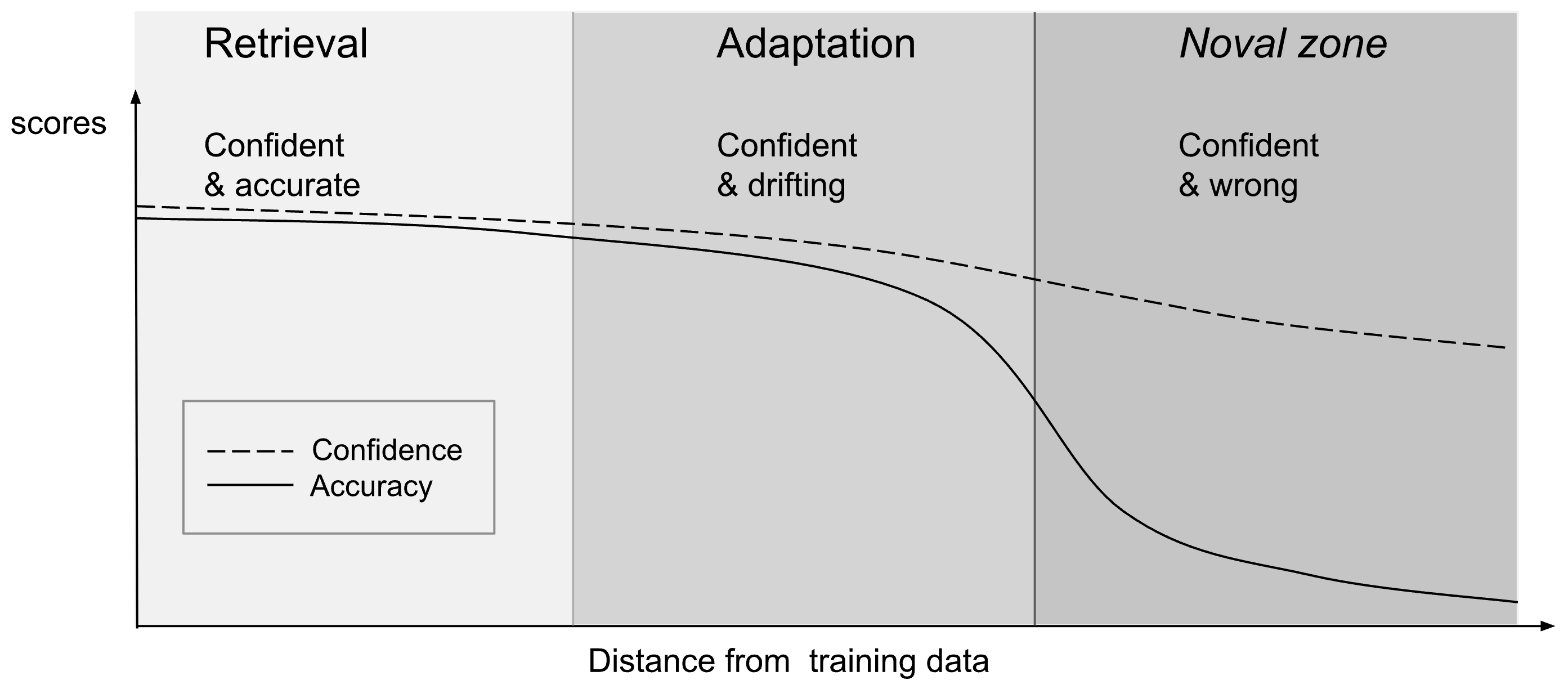
This relies on one assumption: that the future will look enough like the past. Most of the time it does, and memorization is remarkably powerful. But when it doesn't, we hit a wall of model performance.
The real limits
AI doesn't struggle with hard problems. It struggles with structurally unfamiliar ones, where the stored patterns no longer map onto reality.
When the world shifts. During COVID, the travel recommendation system broke, because human travel behavior changed due to pandemic-driven visa constraints, quarantine policies, and fear of infection. The model has no historical pattern that matches the new situation.
The same happens with any cold start problems: a product launching in a new culture, a market reacting to a new event. These aren't bugs. They're the built-in limits of any system that mostly interpolates from what it's already seen.
When causation matters, not just correlation. Umbrella sales and traffic accidents both rise on rainy days. Without understanding that rain causes both, you might wrongly conclude that banning umbrellas would reduce accidents.
Many AI models mainly work on correlation and are therefore limited there. Recent reasoning LLMs seem better at tracing causal patterns, but they’re still limited to the reasoning patterns in the training data, and can't really go beyond them.
When you need to touch the real world. You can train a model on every published chemistry paper in history. It can effectively narrow the search space for drug candidates, but it still can't tell you whether a new drug candidate will work in a living human body. That requires running the experiment.
The same applies to robotics: AI trained in simulated environments still requires trial and error in the real world. Some signals can't be extracted from any dataset. They have to be generated through interaction with reality.
When goals are contested. Should a city optimize for growth, sustainability, or equity? Should an app optimize for profit or user wellbeing? These aren't prediction problems. They involve competing values, where pattern matching can’t tell you which value should win. That's a human question, not a data question.
These aren't edge cases. They describe some of the most important problems humans want to tankle: scientific breakthroughs, policy decisions, strategic pivots. When the situation is truly new, memorization helps less and less.
Beyond memorization: what humans add and how AI can help
Human intelligence also runs on memorization. Charles Darwin built his theory over decades of observation and reading across geology, economics and natural history. Issac Newton stood on the shoulders of giants. Every great innovator built on a large foundation of retained knowledge.
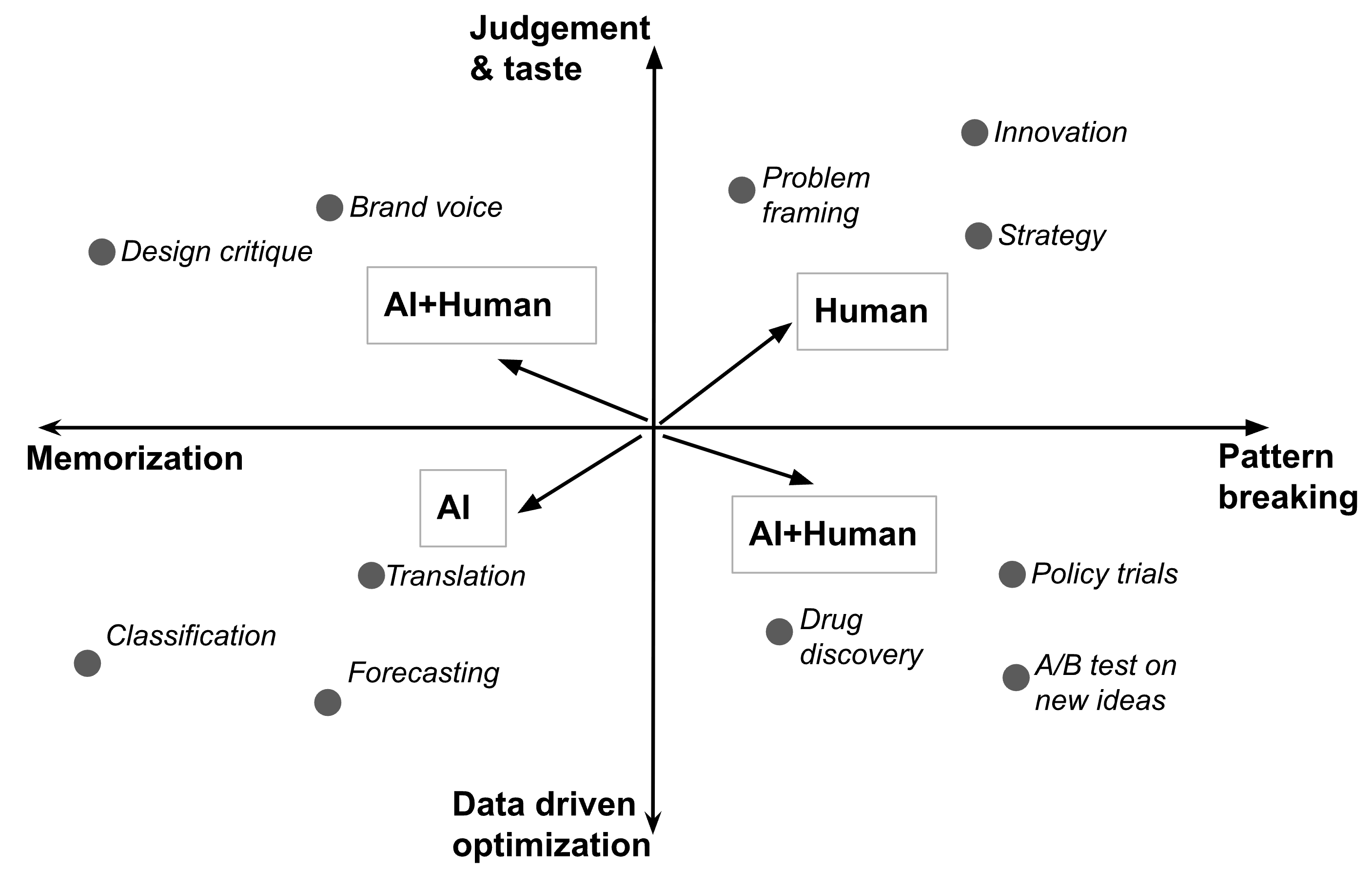
But humans can do something on top ofmemorization that current AI still can't. We question the frame by asking "what if we're solving the wrong problem?". We reason about causes, not just correlations. We make judgment calls when the data is incomplete. We connect ideas across different domains to create something genuinely new.
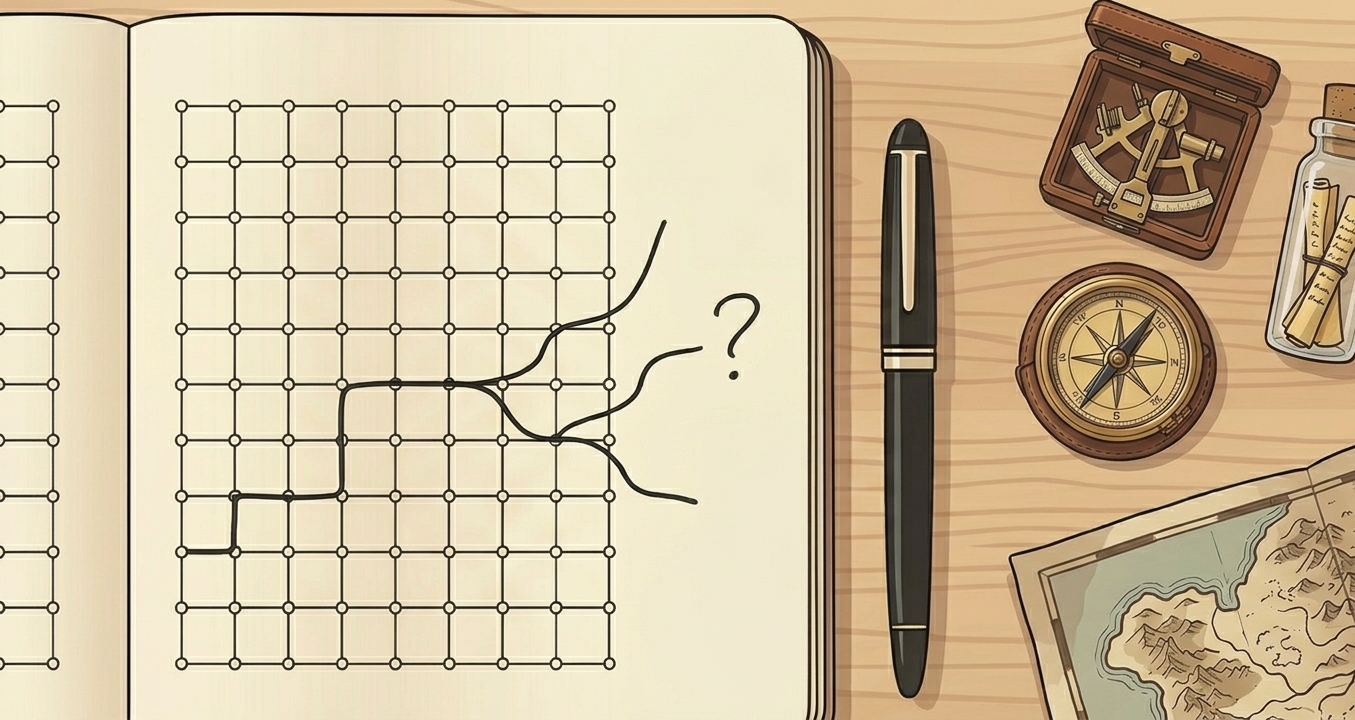
These capabilities all share one trait: they require stepping outside the patterns rather than following them. They require noticing when the map no longer matches the territory, and having the judgment to act on that mismatch.
That extra step is small in volume but huge in impact. It's the difference between optimizing a system and creating a new system.
AI can support this kind of work well. It compresses context, surfaces relevant evidence, and frees you up so you can focus on the thinking that matters.
What this means for you
If you've followed this series, you now have a mental model for AI that's more useful than "it's magic" or "it's just statistics." Here's what to do with it.
Hand over the memorization, not the thinking. Humans are mediocre memorizers. We forget relevant details, miss patterns in large datasets, and struggle to hold more than a few variables in our heads at once. AI doesn't have these problems. Use it for what it's genuinely better at: searching large solution spaces, surfacing relevant past cases, drafting first versions, catching patterns you'd miss. Then you do the part that actually matters: deciding what's right, what's missing, what doesn't fit, and what to do about it.
Take an honest look at your own work. How much of your day involves matching known patterns to familiar problems? Generating routine reports, replying common questions, writing test cases for code, sharing your past best practices? This type of work is right in AI’s sweet spot. You should leverage AI to accelerate the workflow and let it consolidate your knowledge and know-hows. This way you will be more efficient and more scalable.
Invest in the skills memorization can't replace: Learn to frame problems well by asking "are we even solving the right problem?" Think about causes, not just what the data shows. Get comfortable making decisions when the answer isn't obvious. Stay close to the real world and ground truth that models miss. Communicate with other people to learn the most from them. Build cross domain thinking and become a pattern breaker.
AI is the most powerful memorization system ever built. It compresses the past and deploys it at a scale no human can match. That alone is enough to transform industries and reshape how we work.
But the past isn't always a reliable guide.
The people who thrive alongside AI won't be the ones who try to out-memorize it. They'll be the ones who understand where memorization ends, know how to use AI well, and are willing to step into territory where no data, no pattern, and no prior reference can tell you what to do next.
That's exactly where the most meaningful work begins. And there's never been a better time to start than now.